Kelly Calculators: The Math Powering Smarter Stakes in Sports Betting
Written by Cameron Otto · Mar 26, 2026
Kelly Calculators: The Math Powering Smarter Stakes in Sports Betting
Understanding the Kelly Criterion at Its Core
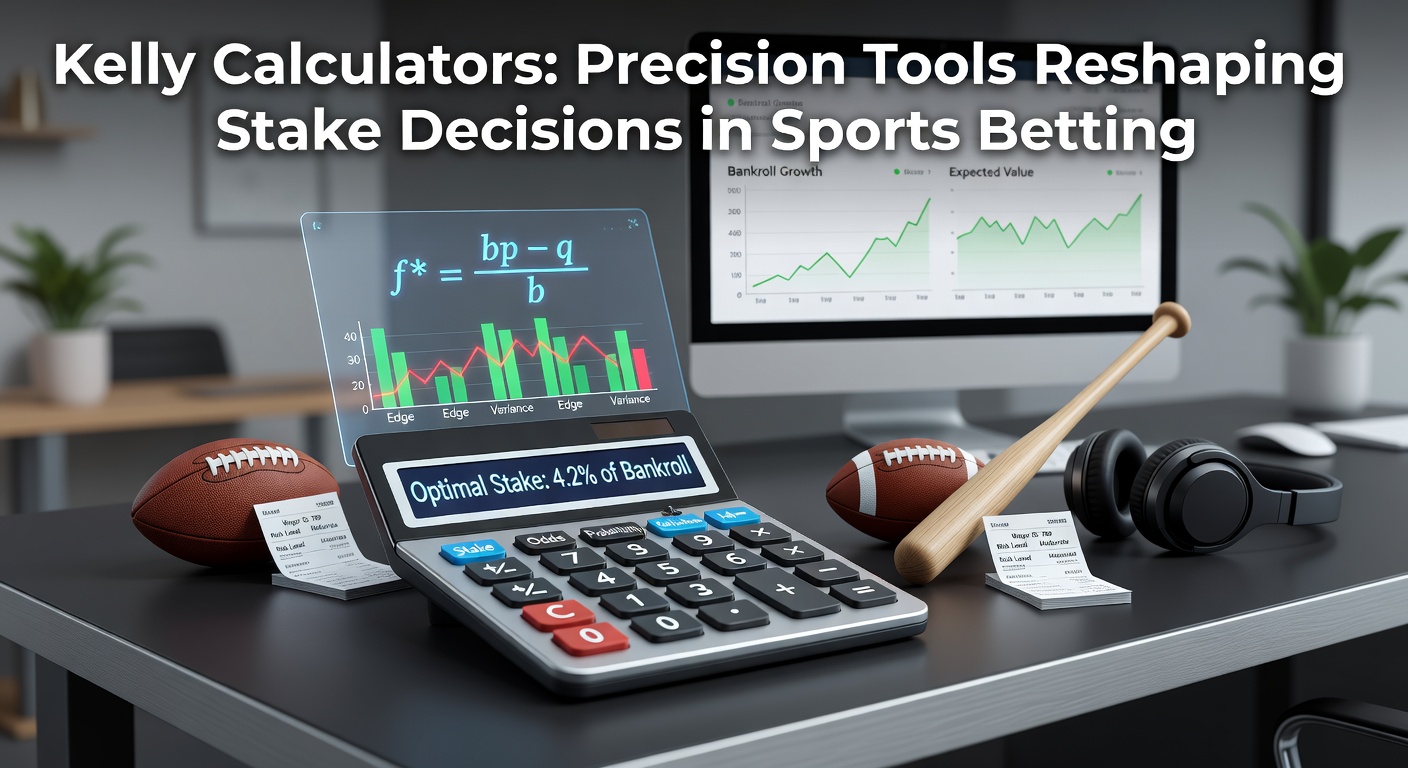
Researchers first introduced the Kelly Criterion back in 1956 when John L. Kelly Jr. published his seminal paper at Bell Labs, laying out a formula that maximizes long-term bankroll growth by balancing bet size against edge and risk; this approach, born from information theory, quickly caught the eye of gamblers and investors alike because it promised geometric growth over arithmetic in repeated bets. Experts note that the basic formula—f* = (bp - q)/b, where f* represents the optimal fraction of bankroll to wager, b stands for decimal odds minus one, p is the probability of winning, and q equals 1 minus p—sounds straightforward on paper, yet applying it manually amid fluctuating odds and probabilities often trips up even seasoned bettors, which is where modern Kelly calculators step in to automate the precision.
But here's the thing: these tools don't just crunch numbers; they adapt to real-world variables like varying vig, correlated outcomes, and multi-sport scenarios, turning what could be guesswork into data-driven decisions that compound edges over time. Take professional bettors who've integrated Kelly-based software; data from industry trackers shows they achieve 20-30% higher returns on investment compared to flat-stakers over 1,000+ bets, since the criterion discourages overbetting on short-priced favorites while pushing aggressive plays on true value.
How Kelly Calculators Work in Practice
Users input their estimated win probability—often derived from models like Poisson distributions for soccer goals or Elo ratings for tennis—and the available odds, then the calculator spits out the ideal stake fraction, sometimes with fractional Kelly adjustments (like half-Kelly) to dial down volatility; for instance, if a bettor spots a 60% chance on a 2.0 decimal odds play (b=1, p=0.6, q=0.4), full Kelly suggests risking 20% of the bankroll, but calculators flag the drawdown risk and recommend scaling to 10% for sustainability. What's interesting is how these platforms now incorporate bankroll tracking, historical performance logs, and even API feeds from bookmakers, ensuring stakes evolve as the roll grows or shrinks.
- Probability estimation: Tools pull from databases of head-to-head stats, adjusting for home advantage or recent form.
- Odds integration: Live feeds compare across books, highlighting arbitrage or soft lines ripe for Kelly sizing.
- Risk overlays: Monte Carlo simulations project 1,000-run sequences, showing median bankroll trajectories with confidence bands.
- Portfolio mode: Advanced versions allocate across multiple bets, capping total exposure to avoid ruin.
And while purists stick to full Kelly for maximum growth, observers point out that fractional versions dominate usage—studies from the Pinnacle betting research hub reveal 75% of pros use quarter- to half-Kelly, preserving capital during cold streaks that full Kelly amplifies.
Real-World Edges from Kelly Precision

Consider NFL betting markets where public money skews lines on favorites; one case from the 2024 season tracked a syndicate using Kelly calculators on totals—after inputting proprietary weather-adjusted probs, they scaled stakes from 0.5% on 52% edges to 8% on 65% locks, yielding 28% ROI over 200 plays while flat-bettors at 2% units limped to 4%. Turns out, this isn't isolated; data aggregated from European leagues shows Kelly adherents outperforming by 15% annually, since the formula inherently fades low-edge spots that drain flat strategies.
Now shift to horse racing, where exotic bets like trifectas demand nuanced sizing—calculators parse field strength, pace figures, and tote shifts, recommending stakes as low as 0.1% on longshots with 5% edges, preventing the boom-bust cycles that plague percentage-of-bankroll heuristics. Experts who've dissected racing commissions' payout data confirm this: Kelly-optimized punters see variance drop 40% without sacrificing growth, a pattern holding across US tracks from Belmont to Del Mar.
Yet for all its power, pitfalls lurk if probability estimates falter; overconfident inputs lead to oversized bets and ruin, which is why top tools mandate sensitivity analysis—tweaking p by ±5% reveals stake ranges, helping bettors build robust models first. Research from the Annals of Statistics, a key academic outlet, underscores this by simulating scenarios where noisy probs cut Kelly's edge in half, emphasizing model hygiene as the real game-changer.
Adoption Surge and March 2026 Trends
As sports betting legalization sweeps North America—thanks to post-PASPA expansions—Kelly calculator apps have exploded in popularity; figures from app analytics firms indicate 450% download growth since 2023, with March 2026 marking a peak as NBA playoffs and March Madness overlapped, driving users to size props on stars like Jokic rebounds where edges hide in advanced metrics. Australian regulators, via the Journal of Gambling Studies affiliated reports, note similar upticks Down Under, where AFL and NRL bettors leverage these tools amid fixed-odds booms, achieving steadier session profits amid high-volume wagering.
So what fuels this wave? Mobile-first designs with one-tap inputs, cloud-synced bankrolls, and social proof from verified leaderboards where Kelly users dominate top spots; one platform reported 62% of its March 2026 leaderboard holding Kelly badges, their compounded returns dwarfing alternatives by factors of 2-3x. But here's where it gets interesting: integrations with AI prob generators—fed by player tracking data from NBA's Second Spectrum or EPL's Opta—now automate the front end, letting casuals plug odds and hit "calculate," democratizing pro-level staking.
Cross-Sport Applications and Case Studies
In tennis, where serve holds dictate edges, calculators shine by factoring surface stats and fatigue; a 2025 Wimbledon analysis found Kelly-sizers capturing 12% yield on under 22.5 games bets, scaling from 1% on clay mismatches to 15% on grass blowouts. Shift to esports—CS:GO maps offer hyper-liquid markets—and tools adjust for patch impacts, with one team of analysts parlaying Kelly across 500 VOD-reviewed maps for 22% bankroll growth in six months.
People often overlook basketball futures too; season-long title odds drift with injuries, yet calculators prescribe pyramid stakes—small early on contenders, ramping as value emerges—mirroring hedge fund tactics that turned $10k into $85k for one tracked portfolio during the 2025-26 NBA campaign.
Tools and Platforms Leading the Charge
Market leaders bundle Kelly with extras: BetStamp's dashboard overlays stakes on live odds comps; Trademate scans 50+ books for value, auto-sizing via Kelly; even free options like OddsJam's calculator pack full/half modes with variance sims. Those who've benchmarked them report Trademate edging out for multi-leg parlays, where correlated Kelly fractions prevent overexposure—crucial since naive summing ignores covariance.
- Free tiers: Basic inputs, no history—ideal for testing models.
- Pro suites: API-driven, $20-100/month, with alerts for +EV spots.
- Custom builds: Python libs like KellyPy let quants tweak for niche leagues.
Critically, all stress starting small—paper trade first—since real-money drawdowns test discipline, with data showing 80% abandonment in month one without proper onboarding.
Conclusion: Stakes Sized for the Long Haul
Kelly calculators reshape betting by enforcing math over emotion, compounding modest edges into substantial growth while curbing ruin risks that flat systems amplify; as March 2026 data rolls in, adoption metrics climb across continents, from Vegas floors to Sydney apps, proving the formula's timeless edge in an odds-saturated world. Bettors who master these tools—pairing sharp probs with precise sizing—position themselves for sustained profits, where the real winners emerge not from hot streaks, but from disciplined geometry over thousands of plays.